
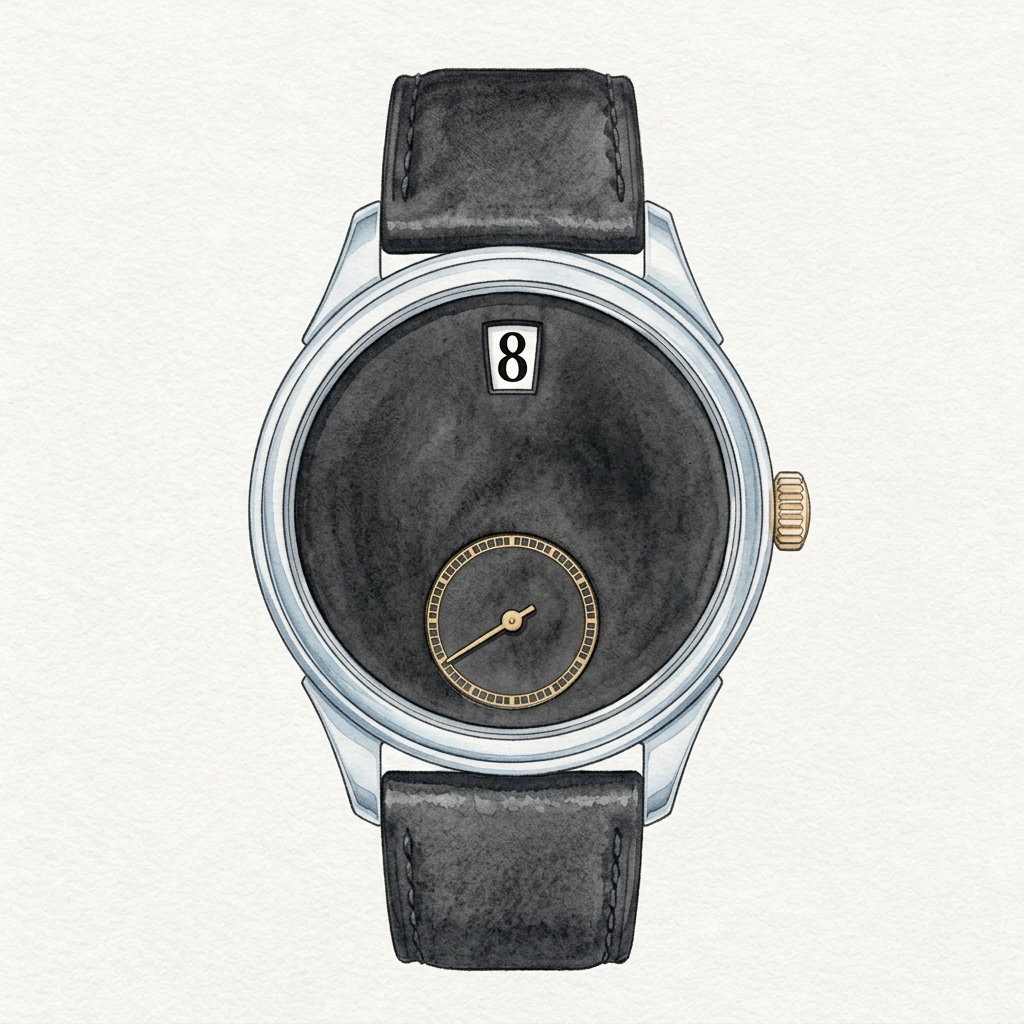
The jumping hour offers many ways of reading time, from a simple aperture to complex digital displays. This selection brings together ten contemporary interpretations to discover in 2026.
1. Reading the aperture
The hour indication stays still between changes, then moves quickly to the next hour, once an hour. The exact duration of the jump depends on the construction. Audemars Piguet describes this principle in its history of the jumping hour.
On a single disc with twelve evenly spaced positions, each jump covers 30°. A 24-hour display may use a different arrangement: the Czapek Time Jumper uses two discs for the hours.
2. Beneath the dial: the mechanics of the jump
Some constructions combine a snail cam, a lever and a spring; others use different devices. The Chanel patent for a jumping-hour display mechanism documents an architecture of this kind. The following diagram shows the principle, without describing every calibre:
Motion works -> Cam -> Spring loading by a lever -> Release at the change of hour -> Display jumpThe amplitude challenge
The design aims to control the energy consumed by the jump and preserve rate stability. A. Lange & Söhne describes the role of the ZEITWERK constant-force device in driving its digital display.
The Module: Barrel & Power Reserve explores how energy is supplied to the movement. Observing the rate and amplitude is covered in the Module: Diagnosis & Timegrapher.
3. Ten models to discover in 2026
This selection includes models introduced in 2025 and 2026, alongside contemporary interpretations whose introduction dates are not specified here.
1. Audemars Piguet — Neo Frame Jumping Hour
Introduced in 2026, the Neo Frame Jumping Hour reinterprets a wristwatch from 1929. Its automatic calibre 7122 drives an aperture display combining jumping hours and continuously moving minutes. Audemars Piguet — history of the jumping hour.
2. Cartier — Tank à Guichets (Cartier Privé)
First created in 1928, the Tank à Guichets was reinterpreted in 2025 within Cartier Privé. The platinum reference WGTA0236 displays jumping hours at twelve and minutes on a disc at six, with the hand-wound calibre 9755 MC. Another platinum version places the apertures at ten and four. Cartier — Tank à Guichets, reference WGTA0236.
3. TAG Heuer — Monaco Speed 12
The official specifications describe twelve rotating hour indicators arranged in a circle and a central minute hand. This arrangement offers a way of reading the hour that differs from a single aperture. TAG Heuer — Monaco Speed 12.
4. Chronoswiss — Delphis Art Deco
The Delphis Art Deco combines a grade 5 titanium case, a laser-textured nickel-plated dial and a gold-coloured minute scale. The jumping hour and retrograde minutes are accompanied by a blue guilloché small-seconds display. Chronoswiss — Delphis Art Deco.
5. Gerald Charles — Maestro GC39 Anniversary
Launched in 2025, this edition reinterprets the 2005 model. It combines jumping hours, central minutes and a lapis lazuli dial, with the automatic calibre GCA3900 in a titanium case water-resistant to 100 metres. Gerald Charles — Maestro GC39 25th Anniversary.
6. A. Lange & Söhne — ZEITWERK DATE (pink gold and grey dial)
Presented in July 2025, this pink-gold version with a grey dial combines a jumping digital display and a peripheral date. Its patented constant-force device helps manage the energy needed to change the indications. A. Lange & Söhne — ZEITWERK DATE 2025.
7. Niton — PRIMA
The PRIMA accompanies Niton’s contemporary revival in 2026. It features a “Totem” jumping-hour display and the in-house calibre NHS01, certified with the Poinçon de Genève. Niton — PRIMA.
8. Baltic × SpaceOne — Seconde Majeure
The Seconde Majeure houses a jumping-hour module developed by Théo Auffret. Hours and minutes appear on sapphire discs, while a large central seconds hand brings movement to the display. Baltic × SpaceOne — Seconde Majeure.
9. MeisterSinger — Edition Panthero Jumping Hour
The hours appear in a round aperture and the minutes are indicated by an off-centre hand. The automatic calibre MS-JH-01 is based on the Sellita SW300. MeisterSinger — Edition Panthero Jumping Hour.
10. Czapek — Time Jumper
Presented in November 2025, the Time Jumper combines an automatic calibre 10.01 with a single barrel and a half-hunter cover. Two sapphire discs display the hours over 24 hours; continuously moving minutes are read around the perimeter. Czapek — Time Jumper.
4. Different architectures and ways of reading time
The Tank à Guichets aperture, the Delphis retrograde minutes and the ZEITWERK discs illustrate several ways of arranging a display. Each construction has its own demands in terms of power transmission and energy management.
Among microfabrication processes, LIGA combines lithography, electroforming and moulding, as explained by the KIT Institute of Microstructure Technology. This process is not electrical discharge machining; mentioning it does not mean that it is used in every model presented here.
To explore the regulating organ’s role in rate stability, see the Module: Regulating Organ & Balance and Hairspring.