
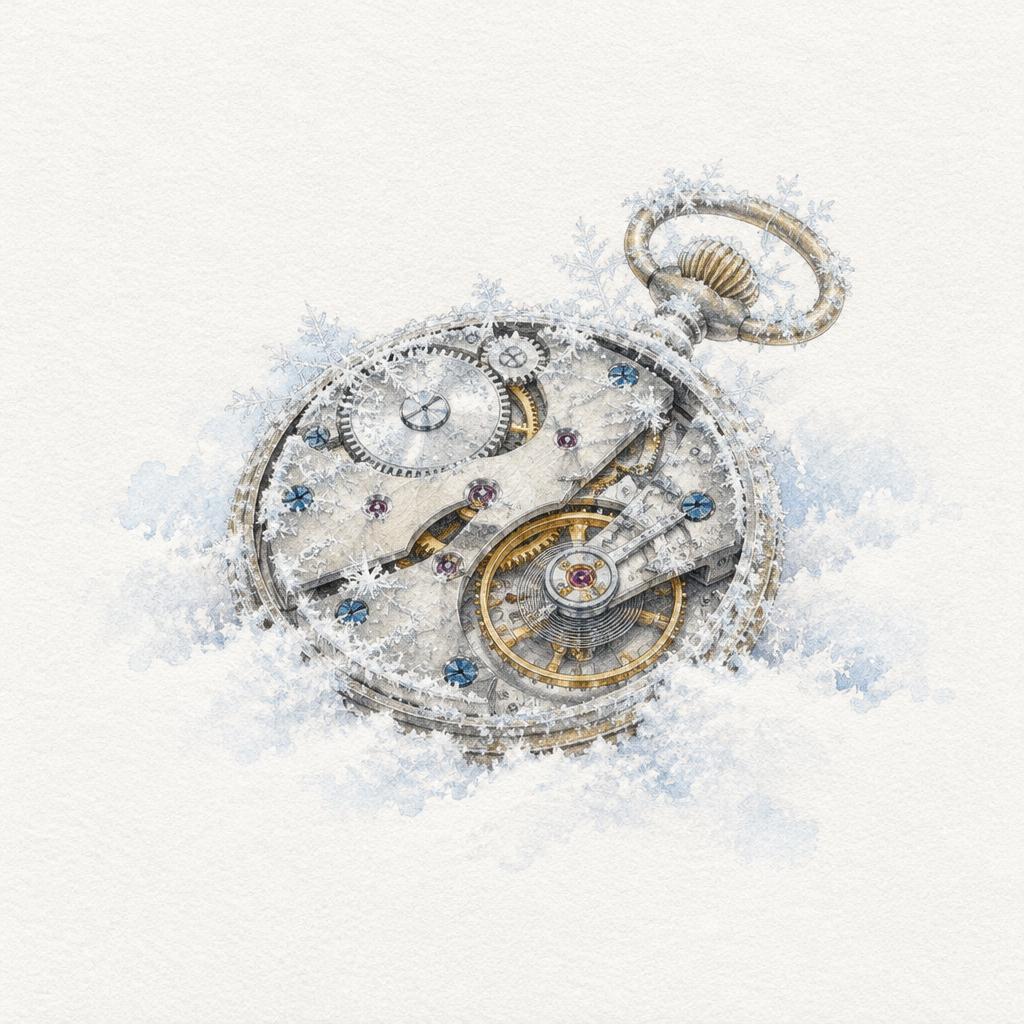
With the first frosts of November and the temperature differences between 0°C outdoors and a heated interior, a watch’s micromechanics faces very real physical stresses. Even protected beneath a sleeve, a watch experiences temperature variations that directly affect two pillars of the movement: the fluidity of its lubricants and the elasticity of its regulating organ.
The viscosity trap: when oil thickens
A modern mechanical watch has several dozen contact points lubricated with oils of very specific viscosities (synthetics such as Moebius oils).
When the mercury falls:
- The kinematic viscosity of the oils increases, making the protective film heavier.
- Friction at the balance endstones and gear-train pivots increases noticeably.
- The driving torque delivered by the barrel (see the Module: Barrel & Power Reserve) suffers transmission losses along the gear train.
The direct result: the balance wheel’s amplitude drops. If the oil is already at the end of its life or partially gummed up, the cold intensifies the effect until the escapement stops intermittently (covered in the Module: Oiling & Watch Lubrication).
The thermal elasticity of the hairspring
Historically, cold posed an even more formidable challenge to watchmakers: changes in the elasticity of metal.
The period of oscillation of a balance wheel depends directly on the elastic modulus (Young’s modulus) of its hairspring. With traditional uncompensated steel, the metal becomes stiffer at low temperatures, increasing the oscillation frequency and making the watch gain time. Added to this is the contraction of the balance wheel itself, whose diameter decreases slightly, reducing its moment of inertia.
To overcome this deviation, watchmakers developed cut bimetallic balance wheels (such as the Guillaume balance) before modern metallurgy brought revolutionary self-compensating alloys such as Nivarox or, more recently, non-magnetic, thermally insensitive silicon (explained in the Module: Regulating Organ & Balance Wheel and Hairspring).
Understanding how cold affects a calibre helps distinguish a simple temperature-related reduction in amplitude from a genuine need for dismantling and cleaning in the workshop.