
It is one of the most frequent cries for help at the bench. A student places a calibre on the timegrapher or a collector looks at their wrist at the end of the day: the watch is not gaining a few seconds, but 15, 30 or 60 minutes a day. The first reaction is often panic: has the regulator moved? Has the mainspring run wild?
The cause is almost always much simpler, invisible and harmless: the hairspring has become magnetised.
What is physically happening at the heart of the escapement?
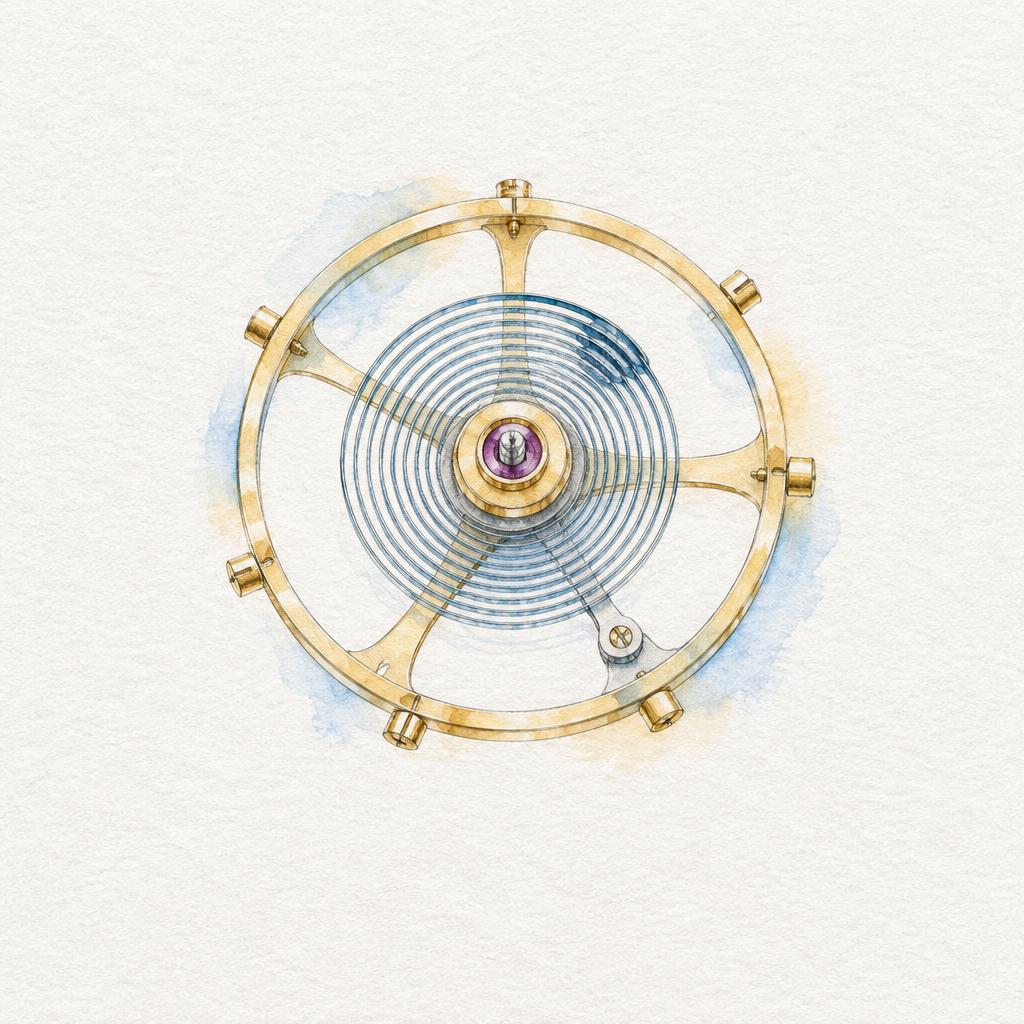
The hairspring is a microscopically thin strip of metal alloy, wound into an Archimedean spiral. For the oscillation to be regular, each coil must expand and contract freely without ever touching its neighbour.
When a watch passes through an everyday magnetic field (a computer speaker, a magnetic tablet case, an induction charger, a bag clasp):
- The metal coils become polarised and turn into tiny magnets.
- Under magnetic attraction, two or three adjacent coils literally stick together.
- The active length of the hairspring is abruptly shortened.
The physics of the balance wheel and hairspring is unequivocal: the shorter a hairspring, the shorter its period of oscillation, and the faster the balance wheel beats. The watch races.
Diagnosis at the bench
Before removing a single bridge, diagnosis takes ten seconds:
- On the test bench: The timegrapher shows a broken line, an outrageous gain or a choppy signal that cannot be stabilised.
- The compass test: Gently bring the watch (or movement) close to a small traditional compass. If the magnetic needle clearly deflects as the case or balance wheel approaches, the verdict is conclusive.
The solution: the demagnetiser
There is no need to adjust the regulator or alter endshake. The repair takes a few seconds using a workshop demagnetiser (tunnel or pulse type).
By exposing the calibre to a diminishing alternating magnetic field, the internal magnetic domains of the steel are returned to a neutral, disordered state. The coils separate instantly, the hairspring resumes its natural concentric breathing, and the watch returns to its usual rate (detailed in the Module: Regulating Organ & Balance Wheel and Hairspring).