
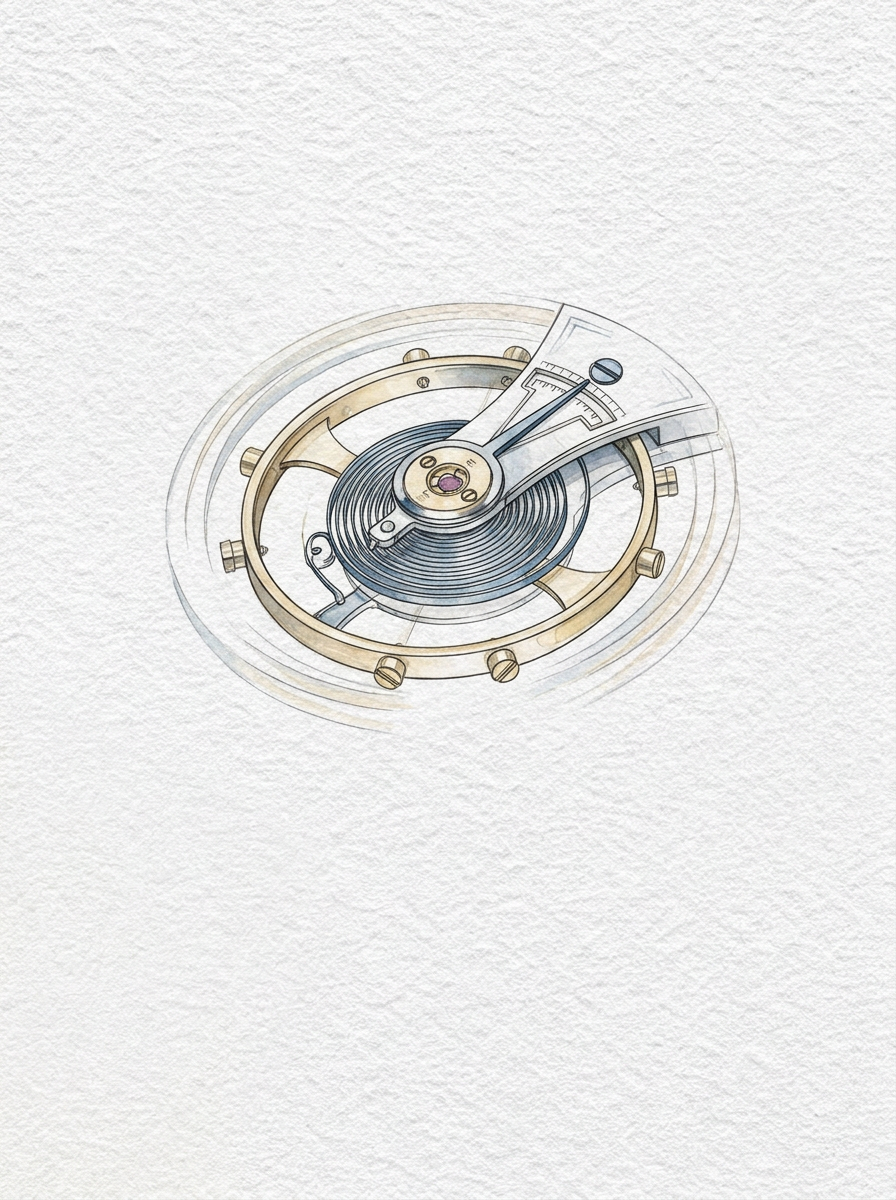
In everyday language, saying that two events are synchronous is enough. In fine watchmaking, isochronism describes a far more demanding property: the ability of an oscillator (a pendulum or a balance wheel and hairspring) to complete its oscillations in a strictly constant time, regardless of their amplitude.
The word derives from the Ancient Greek isos (“equal”) and khronos (“time”). According to his pupil Vincenzo Viviani’s account, it was while watching a lamp swing in Pisa Cathedral in 1583 that Galileo is said to have sensed that large and small arcs of a circle seemed to be travelled in the same interval of time.
Yet in the physical reality of a mechanical watch, perfect isochronism does not exist.
As the mainspring unwinds (see the Module: Barrel & Power Reserve), the driving force delivered to the escapement weakens and the balance wheel’s amplitude drops (for example, from 300° to 220°). If the system is not strictly isochronous, this change in amplitude alters the period of oscillation: the watch begins to gain or lose time towards the end of its power reserve.
Several physical disturbances stand in the way of this ideal:
- Air resistance, which varies with the speed of the balance wheel.
- Internal friction in the metal coils and the adhesion of the hairspring at its attachment points.
- The influence of pivot friction against the endstones in different positions (horizontal or vertical).
To tame this flaw, Abraham-Louis Breguet devised his famous overcoil (raising the final coil of the hairspring to force it to breathe concentrically). Later, the physicists Edouard Phillips and Charles-Edouard Guillaume refined the mathematical calculations and metallurgy to neutralise thermal and elastic deviations (studied in detail in the Module: Regulating Organ & Balance Wheel and Hairspring).
The pursuit of isochronism is the noble calling of the adjuster: ensuring that measured time remains unaffected by the whims of the energy remaining.