
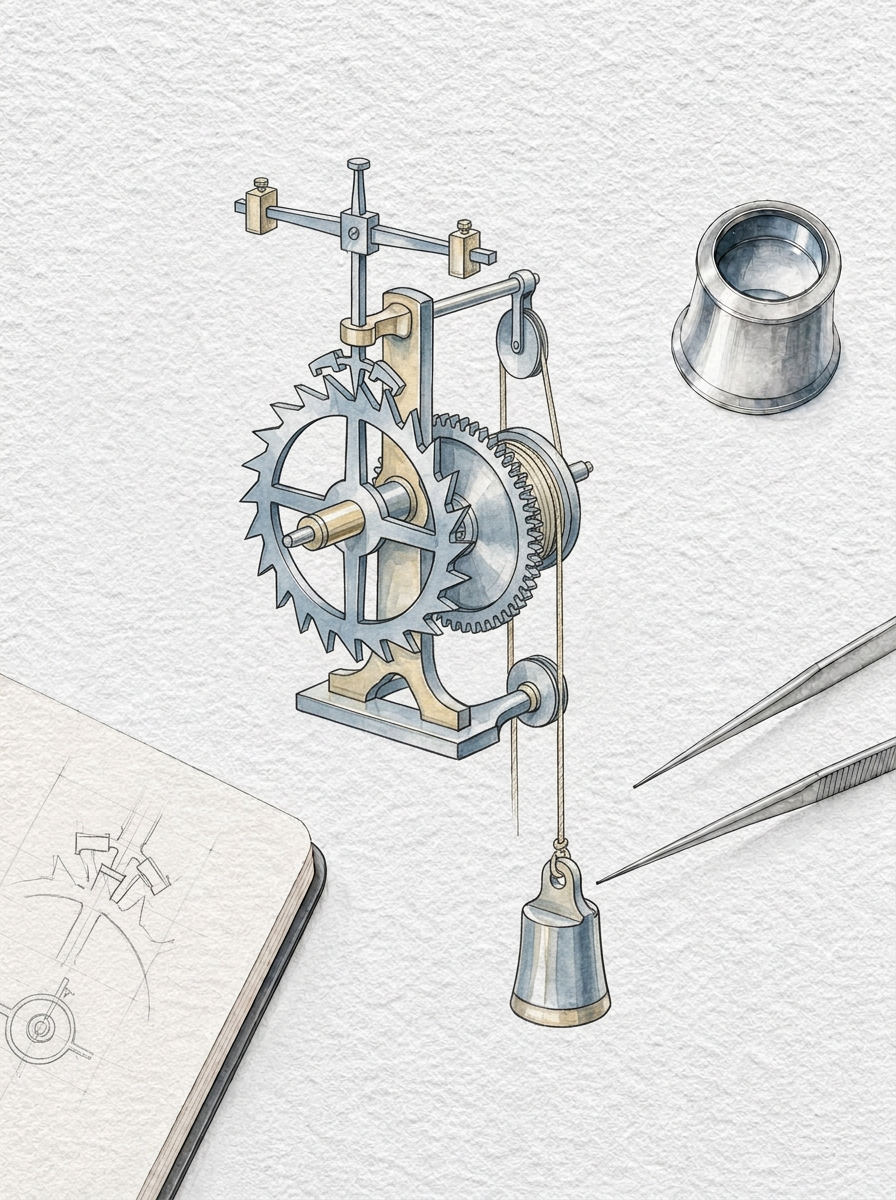
Before it became a matter of millimetres, mechanical timekeeping began as a struggle against the natural acceleration of falling bodies.
In the late 13th century, Europe’s first monumental clocks had no dials: they served to ring the bells of monasteries and towns. Their beating heart relied on an anonymous but revolutionary invention: the verge escapement, paired with a regulator called a foliot.
The foliot: taming gravity
In these early mechanisms, a weight suspended from a rope unwinds a drum. Without regulation, the weight would fall with increasing speed, running the clock down in seconds.
The verge escapement introduced an interruption. A wheel with saw-shaped teeth (the crown wheel) pushes alternately against two small pallets fixed to a vertical arbor (the verge). Each time a tooth escapes, the other pallet blocks the wheel on the opposite side. At the top of this arbor sits the foliot: a horizontal bar fitted with adjustable lead weights.
The mechanism works through sheer inertia: the energy of the weight forces the foliot to turn in one direction, then the opposing pallet slows it and forces it back the other way.
The problem? This escapement has constant “recoil”: with each beat, the momentum of the foliot forces the driving wheel to turn slightly backwards against the force of the weight. Above all, the system is inherently non-isochronous. The slightest dust, condensation on the gears or a change in grease thickness directly alters the speed of oscillation. The result: a daily deviation of around a quarter of an hour, sometimes more.
1656: the Huygens breakthrough
For almost four centuries, despite numerous adaptations in domestic clockmaking, the verge remained the sole ruler. It was not until 1656 that the Dutch scientist Christiaan Huygens, drawing on Galileo’s geometrical observations, first adapted an oscillating pendulum to a mechanical clock.
The paradigm shift was radical:
Where the foliot had depended entirely on the force of the gear train to set its rhythm, the pendulum now imposed its own natural frequency, dictated by gravity and its length. Overnight, the daily error fell from several tens of minutes to less than a minute a day.
But the verge immediately revealed its limitations with this new regulator: the large angle of oscillation it requires (around 80 to 100°) disturbs the pendulum’s isochronism. London and Paris craftsmen realised that this amplitude had to be reduced and the regulator freed (concepts explored further in our Module: Escapement Theory).