
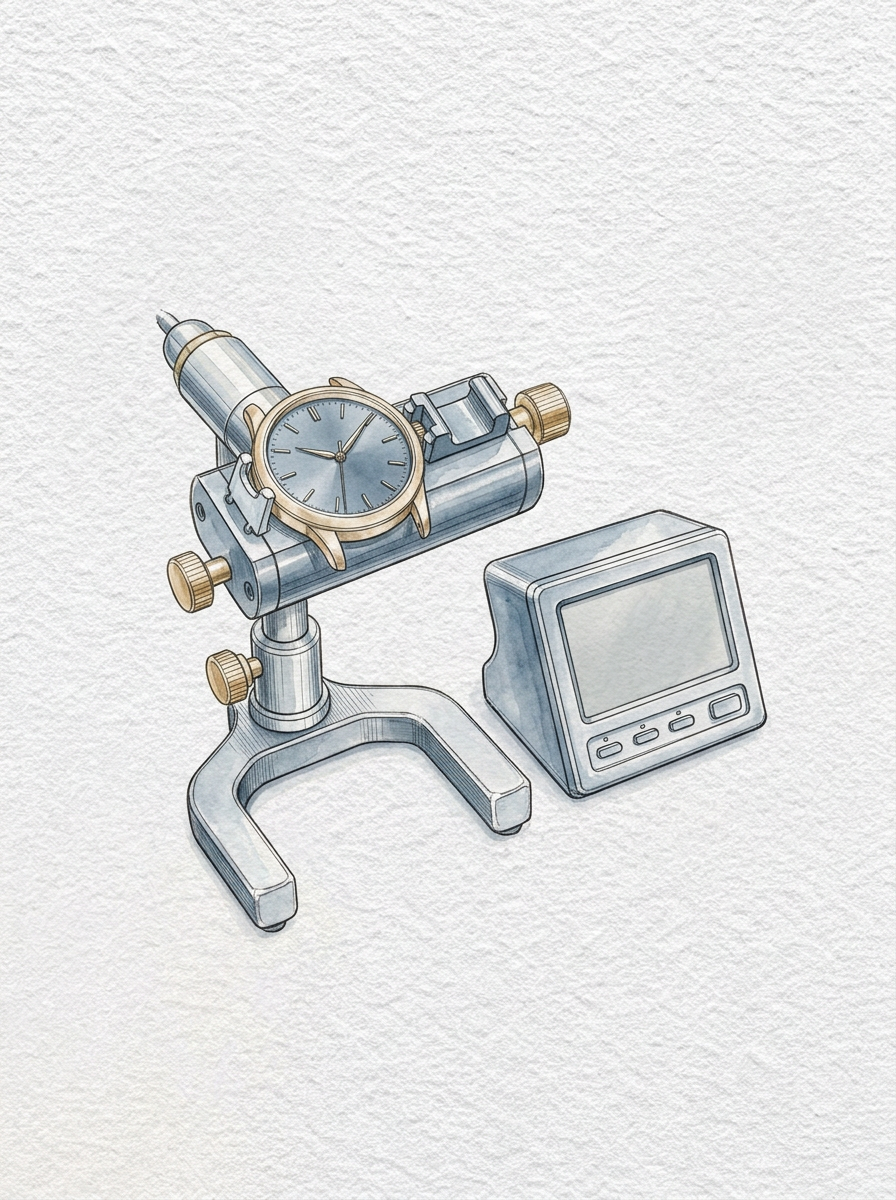
On the bench, with its small LCD screen and articulated watch holder, it may not look like much. Yet the timing machine (often called a Timegrapher, after the brand name that became generic) is the tool that turns the barely audible sounds of the escapement into a mechanical electrocardiogram.
Whether you are a student adjusting your first balance wheel or a collector inspecting a vintage piece before buying, knowing how to interpret its data can prevent many disappointments.
       Amplitude (ex. 285°)
             │
[ +4 s/j ] ──┼── [ 0.1 ms ] ─── Repère (Beat Error)
    │
Marche journalière
How does sound capture work?
The timegrapher does not analyse the time shown by the hands. It listens. Using a highly sensitive piezoelectric microphone mounted on the holding clamp, the device picks up the three distinct sounds generated with each beat:
- The contact of the impulse jewel against the fork of the pallet fork.
- The impact of an escape-wheel tooth on the locking face of the pallet stone.
- The drop of the other pallet stone onto the opposite locking surface and the stop against the banking pin.
From this acoustic interval, repeated thousands of times an hour, the device extracts three fundamental values:
- Daily rate (Rate, in s/day): The theoretical gain or loss calculated over 24 hours. A watch showing +4 s/day gains four seconds a day in the position being tested.
- Amplitude (in degrees, °): The total angle travelled by the balance wheel during its oscillation relative to the equilibrium point. A healthy, well-lubricated movement generally oscillates between 270° and 315° in a horizontal position when fully wound. An amplitude below 220° almost always points to congealed oil, a tired spring or incorrect gear clearance.
- Beat error (in ms): This measures the symmetry of the oscillation. At complete rest (with the mainspring let down), the impulse jewel must lie exactly on the line connecting the centre of the balance wheel to the centre of the pallet fork (explained in our Module: Regulating Organ & Balance Wheel and Hairspring). If it does not, the balance wheel takes longer to turn in one direction than the other. Workshops generally aim for a beat error below 0.4 ms.
Reading the graphical trace
Beyond the figures, the line drawn on the screen tells the intimate story of the calibre’s condition:
- Two straight, parallel, clear lines indicate a perfectly stable regulating organ.
- A line sloping upwards signals a gain; downwards, a loss.
- Scattered traces resembling “snow” betray poor contact, a dirty pivot or a magnetised escapement.
- A regularly undulating, wave-shaped line often points to an out-of-round escape wheel or a bent pinion (details in the Module: Swiss Lever Escapement).
For collectors, the timegrapher provides factual certainty where sales arguments remain vague. For watchmakers, it is the indispensable guide before any final adjustment of the regulator.