
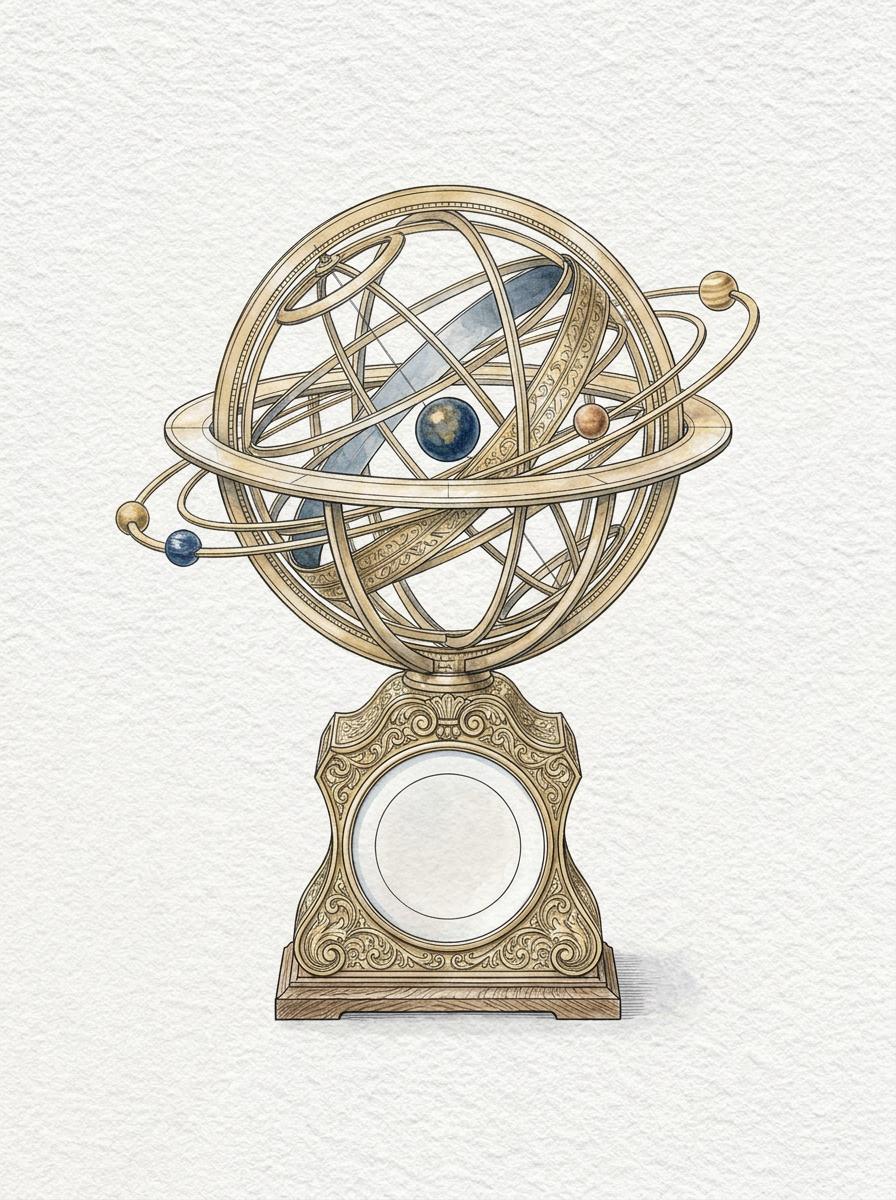
When we think of the golden age of French watchmaking in the late 18th century, the name Abraham-Louis Breguet immediately comes to mind. Yet at the same time, a genius from Franche-Comté was taking astronomical precision and the complexity of gearing to heights still unsurpassed: Antide Janvier (1751–1835).
Born in Briva, a hamlet of Lavans-lès-Saint-Claude in the Jura, the son of an educated peasant, Janvier showed astonishing abilities in mathematics and astronomy from childhood. At just fifteen, with no formal academic training, he designed and built a moving sphere that faithfully reproduced the revolutions of the known planets.
Celestial mechanics on the wrist of history
Admitted as a master clockmaker, Janvier settled in Paris and received the title of Clockmaker to the King in 1784. His creations did more than divide up the hours: they translated Kepler’s equations and Newton’s laws into brass and steel. His masterpieces — planetary clocks, geographical clocks and armillary spheres — calculated eclipses, tides, the rising of celestial bodies and irregularities in lunar motion.
Janvier was also one of the first to study mechanical resonance, developing clocks with twin regulators beating side by side to cancel out mutual disturbances — a principle still used by some contemporary masters.
Weathering the upheaval
The French Revolution shattered his royal career but did not stop his thinking. He took an interest in the decimal time introduced by the Convention and built double-dial clocks (dividing the day into 10 hours of 100 minutes of 100 seconds). Under the Empire, despite the relative protection of scientific figures, Janvier struggled to find his place in an emerging industrial society that valued mass production over unique astronomical works.
Antide Janvier died in poverty and relative obscurity in Paris in 1835, leaving theoretical treatises of exemplary clarity. He embodies that rare breed of clockmaker for whom mechanics was not simply a trade of assembly, but the language through which humanity could give a tangible rhythm to the laws of the cosmos.