
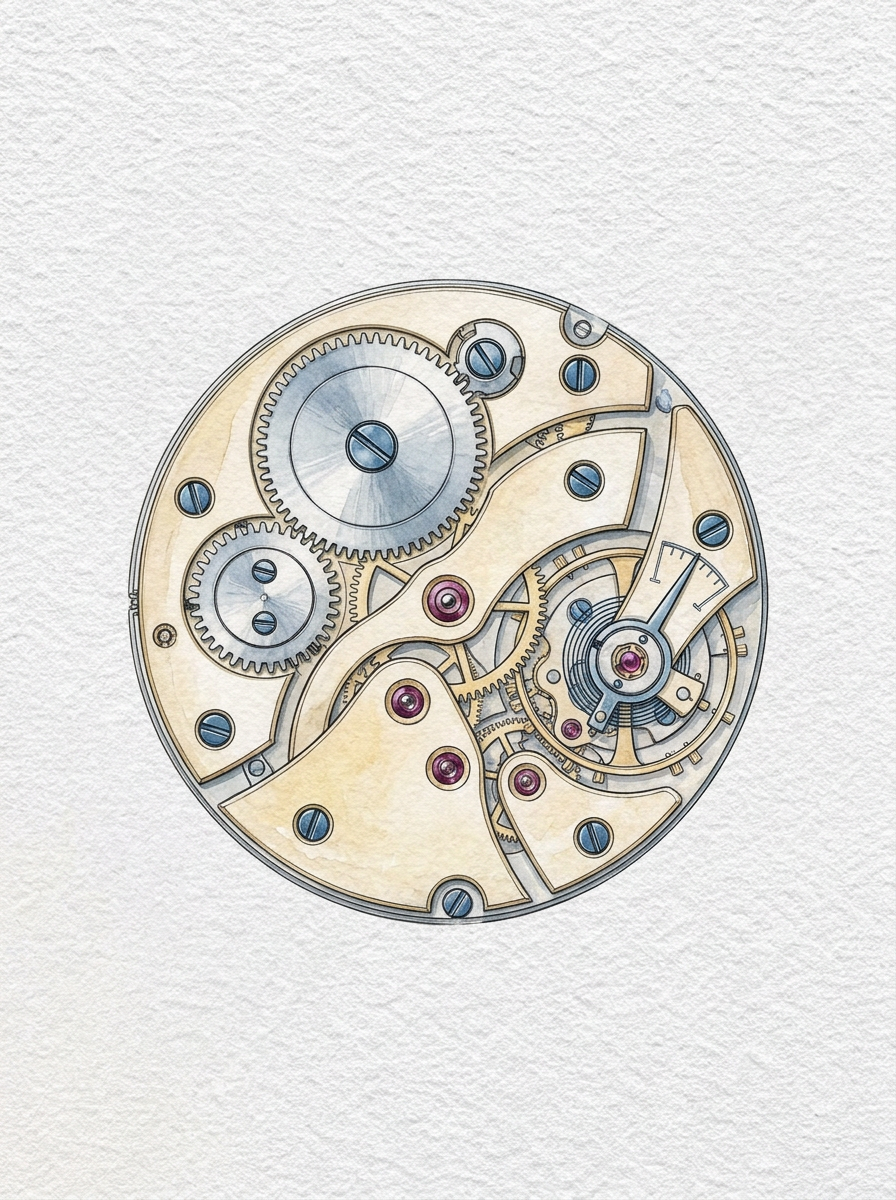
Designed in 1971 by the Peseux ébauche factory, a member of the Ebauches SA group, then taken over by ETA in 1985, the Peseux 7001 (later ETA 7001) remains one of the most endearing hand-wound movements in watchmaking. Compact, measuring 10½ lignes (23.30 mm in diameter) and just 2.50 mm high, it has powered both ultra-thin dress watches from Blancpain, Omega and Baume & Mercier and contemporary creations from Nomos (as the basis for its Alpha calibre).
A pared-back architecture
What strikes you as soon as you place the 7001 in a movement holder is the clarity of its layout. Unlike contemporary calibres with a single large bridge, the Peseux preserves a classical Swiss tradition:
- An independent barrel bridge.
- A separate train bridge holding the centre wheel, third wheel and fourth wheel.
- A tiny pallet bridge and a clearly exposed balance cock.
This architecture makes kinematic analysis crystal clear for a student. Torque passes from the barrel drum directly to the centre-wheel pinion, distributing energy at 21,600 beats per hour (3 Hz) with a power reserve of around 42 hours. For observing the layout of the gear train, this calibre directly echoes the principles of gear reduction covered in our Module: Architecture & Gear Trains.
What it teaches at the bench: points to watch
Beneath its apparent simplicity, the 7001 is unforgiving. Its slimness demands very tight axial tolerances.
The classic pitfall lies in the winding mechanism and fitting the train bridge. With very fine pivots and closely spaced wheels, forcing a bridge into place without checking that the pivots are correctly aligned in their jewel bearings inevitably leads to a broken fourth-wheel or escape-wheel arbor.
Another technical particularity is handling the ratchet wheel and crown wheel. In an ultra-thin movement, the barrel has little room to spare; winding must be gentle, and the barrel’s endshake must be checked meticulously to avoid any unwanted friction against the mainplate or barrel bridge (detailed in the Module: The Barrel and Mainspring).
The Peseux 7001 shows that mechanics need not multiply complications to achieve elegance: a sound gear train, controlled proportions and geometry designed to last.